Startup Equity Calculator
Deciding how to split equity between co-founders is one of the most consequential decisions you'll make before incorporating. Get it wrong and it causes founder disputes, signals risk to investors, and can hold up a funding round. Answer a few questions below and our calculator will give you a data-driven starting point for the conversation.
Startup Equity Calculator
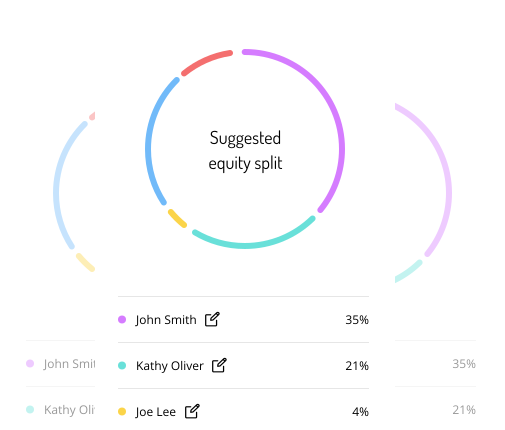
How the equity split calculator works
The calculator walks you through a set of weighted questions about each co-founder's contributions: time commitment, idea origination, domain expertise, capital invested, and execution role. It scores each founder's inputs and returns a recommended equity percentage for each person.
The result is a starting point for the conversation — not a legal document. Once you've agreed on a split, the next step is to incorporate and issue shares with those percentages locked in from day one.
Key factors in a fair equity split
Most equity disputes happen because co-founders never explicitly discussed what each person was actually contributing. The factors that matter most are:
- Time commitment. A founder working full-time is contributing more than one working part-time — even if they joined at the same time. If one founder plans to go full-time immediately and another in six months, that gap should be reflected in the split.
- Idea and IP. The person who originated the core idea or contributed intellectual property at founding typically justifies a larger stake — but this factor is often overweighted. Execution matters more than the idea over time.
- Domain expertise. Technical, industry, or network expertise that is genuinely hard to replace has real equity value. A co-founder who is the only person who can build the product or open the critical customer relationships is not interchangeable.
- Capital contributed. If one co-founder is investing personal capital at founding, that contribution can be treated as equity rather than debt. Separate it from the role-based split so it doesn't distort the overall picture.
- Future responsibilities. Think about who will be doing what in 12 months, not just today. A 50/50 split that reflects equal effort now can create resentment later if roles diverge significantly.
For a deeper look at how these factors play out in practice, see our guide on founder vesting schedules and best practices.
Common equity split models
- Equal split (50/50 for two founders, 33/33/33 for three). The most common arrangement and the simplest to agree on. It works well when both founders are contributing equally across all factors, working full-time from day one, and joining at the same time. When in doubt and contributions are genuinely equal, equal is usually right.
- Unequal split (60/40, 70/30). More appropriate when one founder is clearly the lead — the primary technical architect, the person with the network that opens the first customers, or the one who originated the core IP. A difference of 10–20 points is meaningful enough to reflect contribution without creating a dynamic where the minority founder feels like an employee.
- Weighted by contribution. Some founding teams use a point-based framework — assigning scores to each factor and converting totals to percentages. This is what our calculator does, and it's a useful method when the contributions are genuinely asymmetric or when there are three or more co-founders.
Regardless of which model you use, the most important companion decision is your vesting schedule. Agreeing on equity without vesting is how co-founder departures turn into lawsuits. The standard is a 4-year vesting schedule with a 1-year cliff — see our complete guide to founder vesting for why this matters.

Distribute equity to advisors, co-founders, and employees

Incorporate in Delaware, the state most favored by US and international investors

Raise money from investors with SAFEs and convertible notes

Hire employees, raise funds, and manage your cap table from one powerful dashboard
What is an equity split?
Equity represents ownership in your company. An equity split is the initial distribution of shares among co-founders when the company is formed. It determines who owns what percentage of the business — and therefore who benefits most if the company succeeds, who has voting control, and what each founder's stake looks like to future investors.
The equity split is set at incorporation. Once shares are issued and vested, changing the split is legally complex and expensive. Getting it right before you incorporate is far easier than fixing it afterward.
Not sure how many total shares to authorize? Read our guide on how many shares a startup should authorize.
FAQs
In most cases a fair equity split can be determined based on the capabilities, availability, and value that each founder contributes to the company. Try answering questions like: Who is working full-time vs part time? Who is investing their own money? Who is contributing intellectual property?
The fact that 10 million shares have been approved doesn't mean that all or even most of them should go to the founders right away. Most entrepreneurs put shares aside in a pool for employee stock options (typically around 10-20%). A new business needs to keep a pool of equity that can be used to pay key employees and advisors as the business grows. For a deeper look at how to structure your option pool, see our guide on how many shares your startup should authorize.
10 million authorized shares is the standard starting point for a Delaware C Corporation. The number itself matters less than how you structure the allocation: typically founders take 7–8 million shares and the remaining 2–3 million are reserved as an employee option pool.
Authorized shares are the most shares that can be given out to shareholders legally. The articles of incorporation for the company determine that number. Issued shares are the total number of shares that have actually been given to shareholders.If a company doesn't issue all of its authorized shares, the total number of authorized shares will be higher than the number of issued shares. The number of shares that can be issued can't be more than the number of authorized shares. To see how authorized and issued shares fit into your overall ownership picture, read our ultimate guide to cap tables.
Transferring fully vested shares after you’ve decided on the initial split is cumbersome and requires the involvement of a transfer agent and lawyers. However if the shares aren’t fully vested, it is possible to reverse the equity grant. Most startups decide to apply the typical 4-year vesting schedule with 1 year cliff as a measure of safety and to set the right incentives for founders and employees. For a full breakdown of how vesting schedules work and why they matter, see our founder vesting schedules guide.
When you raise money for your startup in a financing round, you authorize new stock, which increases the total number of outstanding shares. This dilutes the stock for the existing shareholders, but also increases the value of your company; it’s a trade-off.
Ready to make your equity split official?
Once you've agreed on the numbers, the next step is to incorporate and issue shares with those percentages locked in. Capbase lets you incorporate your Delaware C Corp, issue founder shares, and set up your cap table — all in about 10 minutes, with no lawyer required.
Related articles
What is an LLC and Why Choose it for Your Business?
Discover why an LLC is a smart choice for your business: offering personal liability protection, tax efficiency, and operational ease, it's ideal for entrepreneurs seeking a balance between security and flexibility.
 by Michał Kowalewski • 7 min read
Northern Mariana Islands Business Entity Registration for Delaware Corporations
Is your company doing business in the Northern Mariana Islands? Get an easy-to-follow explanation about what forms you’ll need, information about registration fees, filing deadlines, naming requirements, and more.
 by Capbase Staff • 7 min read
American Samoa Business Entity Registration for Delaware Corporations
Is your company doing business in American Samoa? Get an easy-to-follow explanation about what forms you’ll need, information about registration fees, filing deadlines, naming requirements, and more.
by Capbase Staff • 7 min read